A family-status housing concern: preserve the actual rule instead of a vague impression
An advertisement or building rule about children can raise a different housing question from whether a household seems like a good fit. Preserve the actual wording and context before accepting a broad preference claim or making your own legal ruling. The file supports fair-housing review without inventing an occupancy limit or declaring every safety-related rule unlawful.
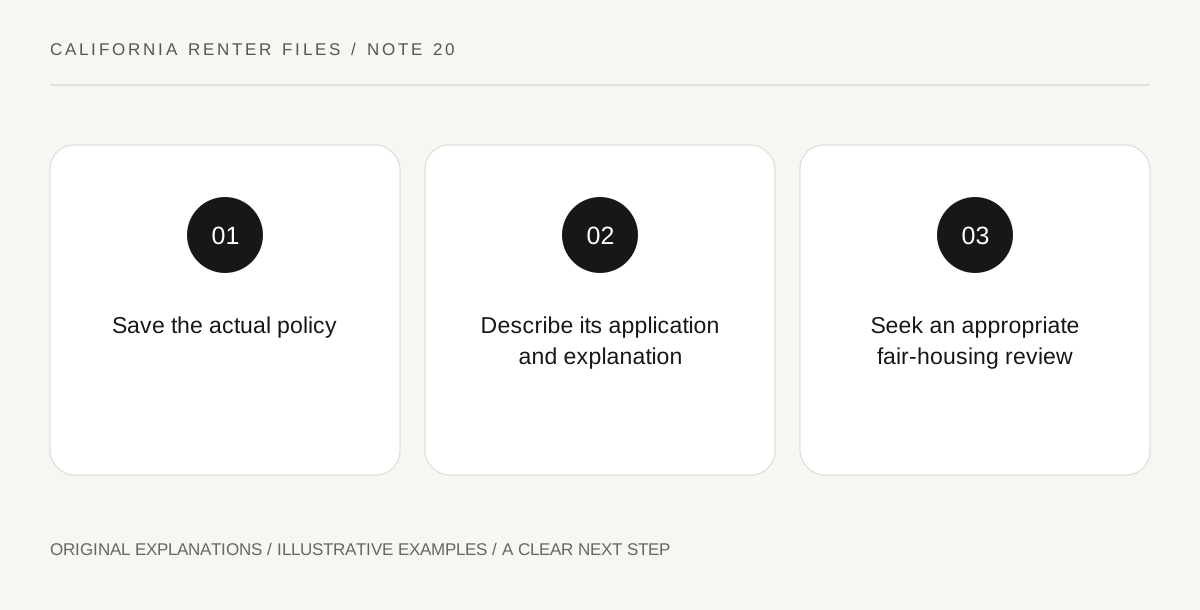
Original explanatory diagram. Read the full method and limitations below.
Use the protected-characteristic context
California’s Civil Rights Department identifies familial status, including families with children and pregnancy, among protected housing characteristics and discusses potentially discriminatory rules. This supplies a fair-housing context, not a conclusion about every property category or rule. Save the exact advertisement, application communication or policy at issue. Do not reduce a specific written restriction to a vague statement that the building dislikes families, because the actual wording and its application matter to qualified review.
Separate the rule from how it was applied
Create one field for the stated policy and another for the action taken in the actual situation. Record dates, the relevant property and the existing communication. If another household’s experience is mentioned, identify it as a report and respect their privacy. Do not pose as a different applicant or arrange a private investigation based on this article. The record should preserve facts already available, without making the person gather evidence through misleading or risky conduct.
Keep safety, occupancy and preference questions distinct
A provider may describe a concern using one of those labels, but the label does not settle its legal basis. Preserve the explanation and ask an appropriate fair-housing adviser or agency how it relates to the actual rule. This article sets no bedroom-to-person formula and does not evaluate an individual household’s lawful occupancy. Avoid turning a reasonable question about children into a demand for unnecessary private family or medical information merely to make the file appear more complete.
Use the appropriate review route promptly
Follow CRD’s current official information and intake process, and obtain qualified advice when an actual dispute or deadline requires it. A complaint or question does not itself establish discrimination or suspend another legal process. Keep confirmation of what was submitted and the original supporting material. The practical outcome is a clear distinction between protected-characteristic context, the actual policy and its application, so a broad phrase about family suitability does not hide the specific housing conduct that needs review.
Illustrative renter file
Illustrative record: an applicant saves an advertisement with a child-related restriction and a later message applying it to their household. The provider’s stated safety explanation is preserved rather than omitted or accepted as decisive. A fair-housing resource reviews the actual facts. The applicant invents no occupancy formula, shares no unnecessary pregnancy details publicly and treats the legal conclusion as unresolved until appropriately assessed.
Questions that come up
Does this article declare every child-related rule unlawful?
No. The actual rule, property coverage and circumstances need qualified review under applicable law.
Can a provider’s safety label alone decide the issue?
No such conclusion is supplied here. Preserve the explanation and ask the responsible fair-housing source about the actual policy and its application.
References and scope
These sources support the factual background. Examples and exercises are original illustrative teaching material. References do not imply endorsement.
- California Civil Rights Department: Housing — Familial status as a protected housing characteristic and potentially discriminatory rules; no universal occupancy limit, exception or case determination.