A rental EV-charging request: separate permission, electrical work, billing and use
An available parking space does not answer every question about installing or using an electric-vehicle charger. Build the request around four distinct roles: property permission, qualified electrical work, billing and the actual parking arrangement. The goal is a concrete reviewable proposal, without assuming a conditional legal rule provides a free installation or permission to run a cable wherever convenient.
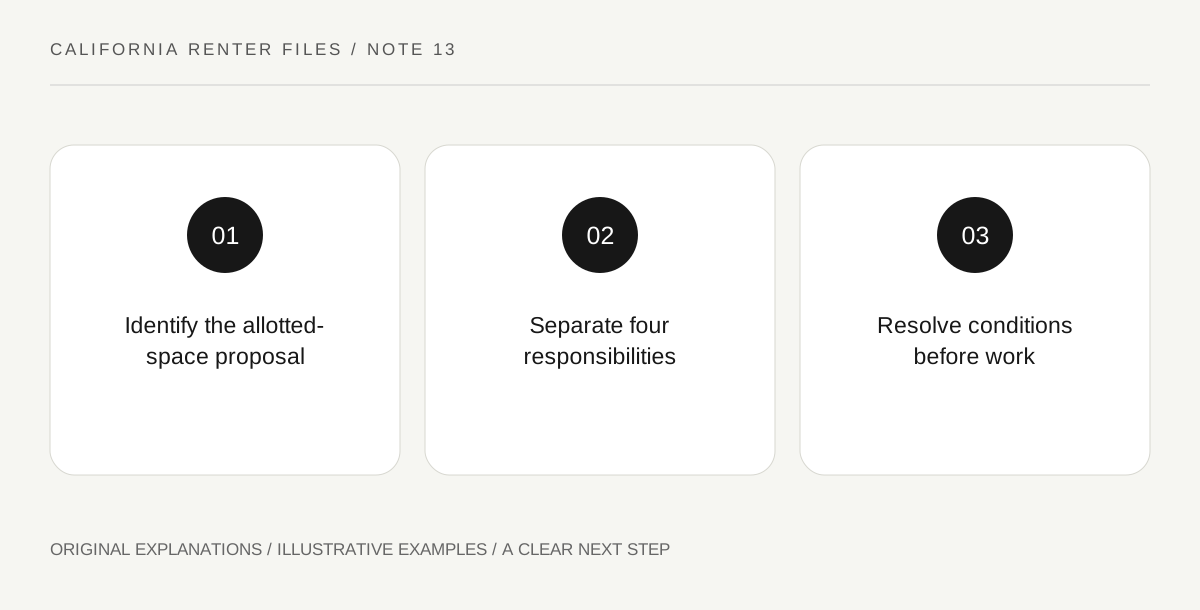
Original explanatory diagram. Read the full method and limitations below.
Identify the actual request route
The City of Dublin’s tenant guidance describes California’s conditional written-request framework for charging installation at an allotted parking space, with exemptions and cost responsibilities. Use that as a starting point for checking current requirements, not a personal coverage determination. Record whether parking is actually included or assigned and which agreement identifies it. A general statement that the building has parking does not establish the rights or technical suitability of one proposed location.
Keep the electrical question with qualified people
Ask the responsible property contact and qualified installation provider what assessment is needed. This article supplies no outlet selection, extension-cord method, electrical capacity calculation or equipment instruction. Do not test a shared circuit or begin work to make the proposal more persuasive. A provider should understand the actual site and the proposed use. Keep any plan, permission and permit questions tied to the exact arrangement rather than a product advertisement that assumes a different property.
Give billing and access separate fields
Identify who would account for installation costs, electricity use, maintenance and any shared-use arrangement, asking the actual parties to clarify responsibilities. Quote no hypothetical tariff as a current rate. An installed device may still have an access or reservation process that affects usability. Conversely, a convenient app does not establish property permission. The file should prevent these issues from collapsing into the single question of whether charging is allowed, because each can require a different responsible answer.
Resolve conditions before treating the proposal as approved
Preserve the written request, supporting information and response. If coverage, conditions or costs are disputed, obtain appropriate current legal and professional advice. Do not treat an informal encouraging comment as approval for physical work. The useful outcome may be a properly scoped assessment or another agreed arrangement rather than immediate installation. This is a rental coordination guide, not a guarantee that every property can accommodate charging or that a tenant may modify parking infrastructure independently.
Illustrative renter file
Illustrative file: a renter has one assigned space and proposes charging equipment. The file separates the written permission question, a qualified electrical assessment, cost accounting and access rules. One responsibility remains unresolved, so no work begins. The renter makes no assumption of a free charger, public eligibility or permission to run an improvised cable from the unit to the parking area.
Questions that come up
Does an assigned space automatically establish installation permission?
No. The cited framework is conditional, and the actual property, agreement and proposal need review.
Does this article approve an outlet or extension cord?
No. It supplies no electrical method or equipment recommendation. Use qualified site-specific assessment and the actual approval process.
References and scope
These sources support the factual background. Examples and exercises are original illustrative teaching material. References do not imply endorsement.
- City of Dublin: Electric Vehicle Infrastructure for Tenants — A conditional written-request framework for allotted rental parking, with exemptions and cost responsibilities; no personal coverage or electrical-installation advice.