A retaliation concern: preserve the sequence without treating timing as the whole proof
An unfavorable housing action soon after a tenant raises a concern can feel self-explanatory. Preserve that sequence carefully, while keeping the protected activity, the later action and the available evidence distinct. A clear chronology helps qualified review; it does not automatically prove retaliation, determine a remedy or make an unrelated notice safe to ignore.
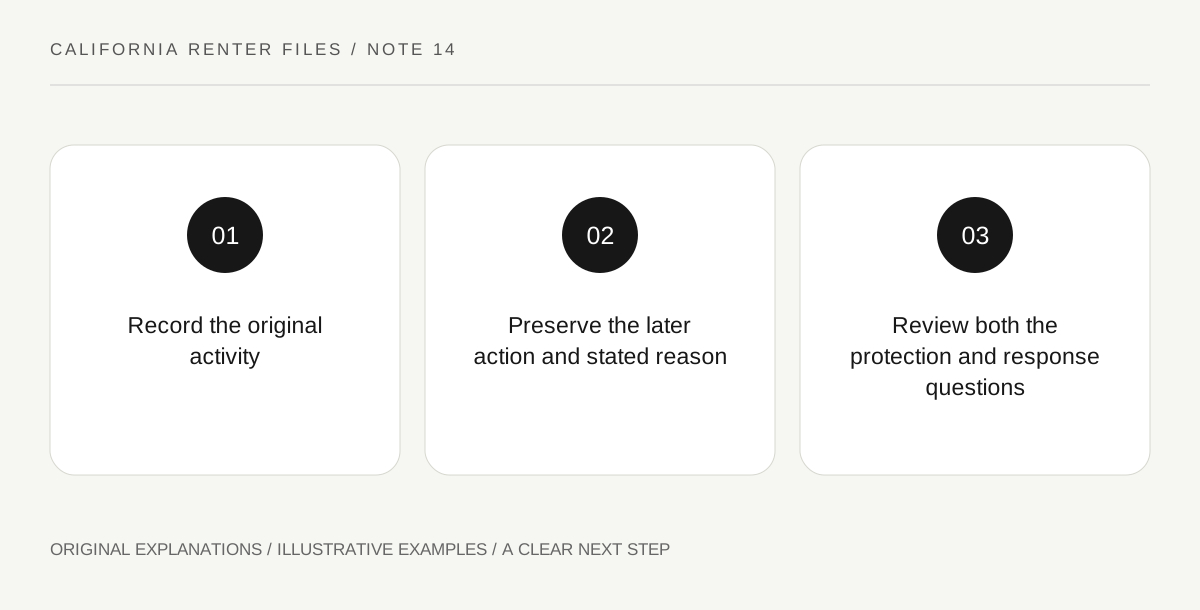
Original explanatory diagram. Read the full method and limitations below.
Use the protection context accurately
California’s Attorney General explains that landlords may not retaliate against tenants for exercising legal rights. That provides a reason to seek review of a concerning sequence, not a ruling about every disagreement after a complaint. Identify the actual activity and the later conduct in plain terms. Avoid labeling every inconvenient response retaliatory before an adviser has examined the applicable law and facts. The record can remain specific and serious without making its legal conclusion in the opening line.
Give each event its own evidence
For the initial concern, save the report or communication and its date. For the later action, preserve the actual document, message or other existing evidence. Mark a recollection as a recollection and keep another person’s report distinct from what you observed directly. Do not edit messages to remove context that seems inconvenient. A qualified reviewer needs the sequence as it happened, including communications between the two main events, rather than a dramatic but incomplete before-and-after pair.
Include the stated reason without accepting it blindly
If management supplies a reason, record it accurately and identify any evidence relevant to that explanation. You do not have to decide its truth to preserve it. This helps distinguish a question about motive from a question about the underlying action’s separate validity. A rent notice, lease issue or court document can have its own response requirements. Do not delay seeking help or ignore a deadline because the file contains a retaliation concern.
Ask for review of both questions
Bring the chronology and original documents to appropriate legal assistance or the responsible agency. Ask about the retaliation issue and the actual action requiring a response. This article supplies no withholding instruction, legal notice or litigation strategy. Its useful outcome is a file that makes sequence, context and competing explanations visible. Timing can be relevant information without becoming the whole analysis, and a careful record can support prompt help without pretending the tenant has already established the case.
Illustrative renter file
Illustrative chronology: a tenant records a dated request concerning a legal right, a later unfavorable action and management’s stated explanation. Messages in between are preserved as well. Qualified assistance reviews both the claimed retaliation and the response needed to the actual document. The tenant does not assume timing alone proves the claim or ignore a separate court or notice deadline while organizing the file.
Questions that come up
Does close timing automatically prove retaliation?
This guide makes no such determination. Timing is part of a factual record that needs review under the applicable rules and circumstances.
Can a retaliation concern make a court paper irrelevant?
No. Seek prompt qualified help about the actual document and any deadline as well as the retaliation question.
References and scope
These sources support the factual background. Examples and exercises are original illustrative teaching material. References do not imply endorsement.
- California Attorney General: Landlord-Tenant Issues — The prohibition on landlord retaliation for exercising legal rights; no evidentiary presumption, case outcome or self-help remedy is asserted.