Berkeley balcony inspections: distinguish a professional program record from a visual guess
A freshly painted balcony can look reassuring without answering a structural inspection question. For a Berkeley rental, identify the city’s actual exterior-elevated-element program and the property-specific record rather than relying on appearance. The task is to ask the right administrative and professional questions, with no tenant-made load test, structural clearance or statewide deadline calculation.
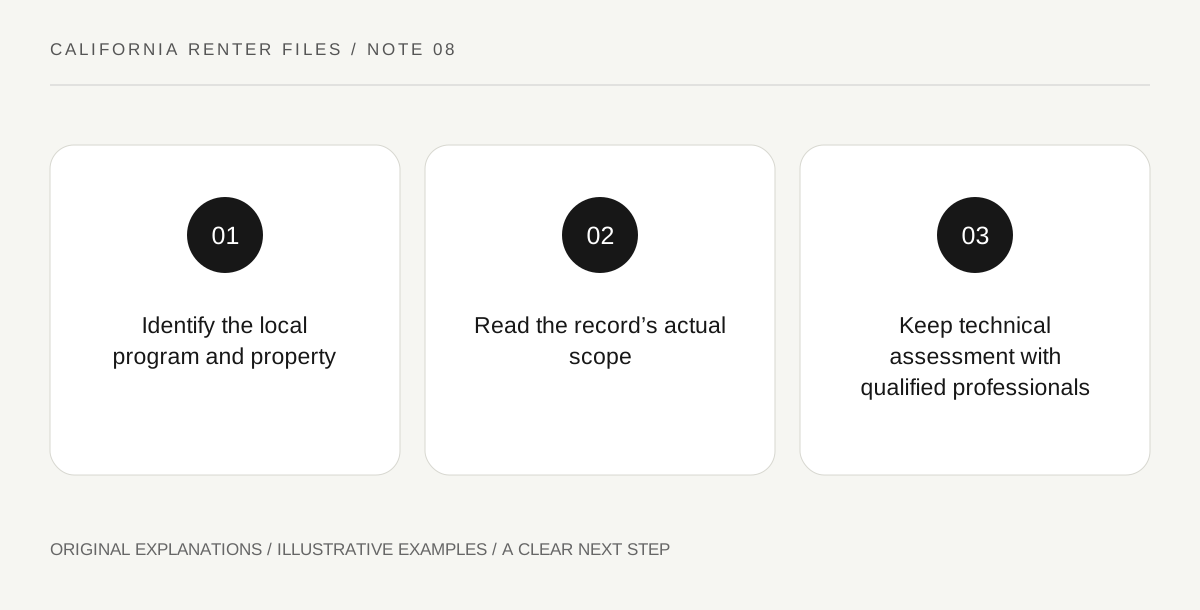
Original explanatory diagram. Read the full method and limitations below.
Use the city-specific program
Berkeley describes an Exterior Elevated Elements program requiring covered owners to obtain qualified inspections and submit certification, with distinctions among property categories. This is a local program description, not a universal rule for every California balcony. Identify the exact property and category through the responsible city service. Do not choose a cycle from an online summary before confirming which requirements apply. A neighboring city’s process or a condominium deadline may not answer the question about a particular rental property.
Ask what the actual record concerns
Request information through the appropriate management or city process about the relevant inspection or certification. Record the property, date, professional role and scope actually identified. Do not assume one document addresses every exterior structure or that a certificate for another building applies to yours. The question is what was inspected and under which program, not whether an attractive PDF looks official. Keep unresolved coverage or scope details visible for the responsible office to clarify.
Keep visible concerns separate from structural conclusions
If a concern is noticed from a safe ordinary position, report the specific observation without testing the structure. Do not jump, add weight, probe material or enter a restricted area to verify stability. A photograph cannot independently establish structural adequacy, and the absence of obvious damage does not make a tenant an inspector. Use responsible local authorities for an immediate hazard and qualified professionals for assessment. Recordkeeping should not delay the appropriate response to a safety concern.
Preserve instructions and current restrictions
Keep any posted restriction or official instruction attached to the file and follow it rather than treating a prior inspection date as permission to disregard a current notice. Ask the responsible service about unresolved status. The useful outcome is a property-specific administrative record and a clear source for technical questions. It does not certify that a balcony is safe for a particular use or decide a tenant’s remedy. Those questions require actual qualified assessment and, where relevant, legal advice about the facts.
Illustrative renter file
Illustrative inquiry: a Berkeley tenant hears that a building was inspected but receives no scope information. They ask the responsible office which record applies to the exact property and keep a posted restriction in the file. A visible concern is reported without a load test. The tenant does not borrow a condominium deadline or treat new paint as a professional structural finding.
Questions that come up
Does new paint prove structural adequacy?
No. Appearance does not replace a qualified inspection. This article supplies no technical clearance or test method.
Can the Berkeley program summary set a deadline for every California rental?
No. Confirm the actual jurisdiction, property category and current requirements through the responsible authority.
References and scope
These sources support the factual background. Examples and exercises are original illustrative teaching material. References do not imply endorsement.
- City of Berkeley: Exterior Elevated Elements Inspection Program — Berkeley’s covered-property professional inspection/certification process and category distinctions; no deadline, load test or structural-safety determination.