A rental flood disclosure: separate the document from a prediction about your home
A flood-related disclosure can be read as either a guarantee of danger or a guarantee that anything not named is risk-free. Treat it instead as a specific information document. Preserve the wording and property identity, then use the responsible current mapping and emergency resources for the different questions they answer, without turning a rental worksheet into a risk model.
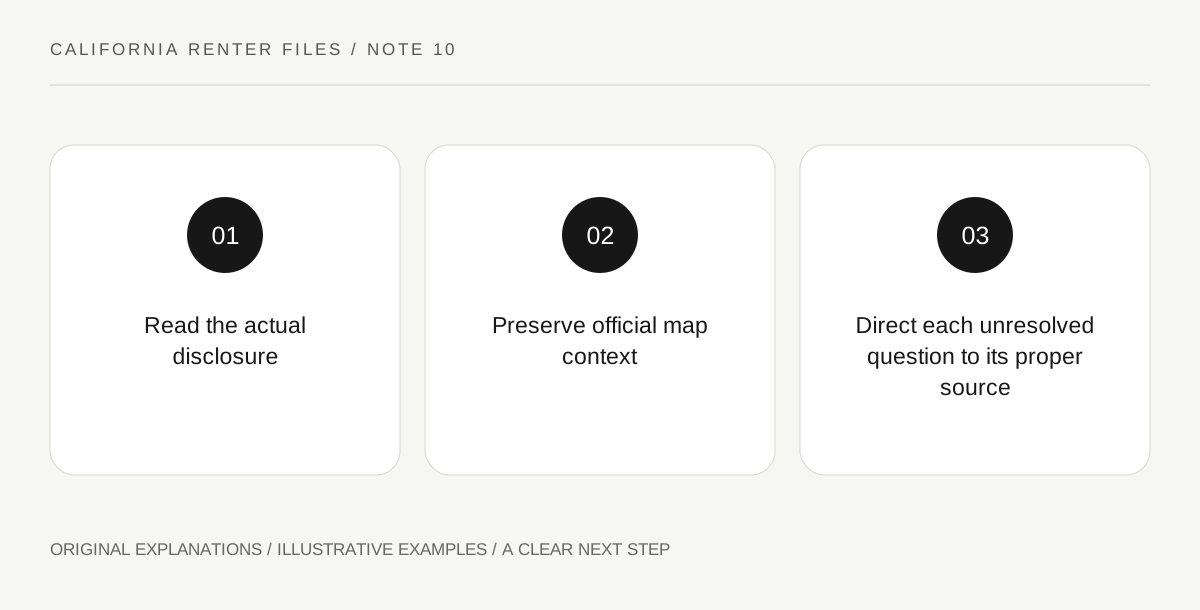
Original explanatory diagram. Read the full method and limitations below.
Identify the conditional disclosure rule
DRE’s 2026 guide describes a flood-hazard disclosure duty tied to an owner’s actual knowledge and the covered agreement context. This is not a statement that a missing page proves no risk or that every disclosure predicts a future event. Record the exact document and the property it identifies. If compliance is disputed, seek qualified advice about the actual duty and facts. Do not turn the presence or absence of a form into a personal legal conclusion.
Keep map identity and property identity together
When consulting an official resource, record its producer, date or version information and the exact address or location searched. Different map layers can answer different questions, so preserve the legend rather than saving only a colored crop. Do not interpret a boundary from a low-resolution image if the responsible authority provides a more suitable property inquiry. This article supplies no flood probability, elevation determination or prediction about whether an individual unit will be affected.
Separate information, insurance and emergency planning
A disclosure, a policy question and an emergency instruction are different documents with different purposes. Ask a qualified insurance source about actual coverage; this article quotes no premium or guarantee. Use the responsible local emergency authority for current orders or alerts rather than a landlord’s old disclosure. An information file should help identify which question belongs where, not merge them into a single reassurance. If an emergency is occurring, respond appropriately rather than pausing to finish the rental record.
Write a summary that preserves uncertainty
End with the disclosure received, the official resource consulted and the unresolved question requiring a responsible answer. Avoid labels such as safe or certain to flood that the evidence does not establish. Keep original pages and dates so the summary can be reviewed. The useful outcome is a clearer distinction among legal information, mapped context and current action, with each retained under its proper source. It does not determine a remedy, make a property insurable or replace a qualified assessment.
Illustrative renter file
Illustrative summary: an applicant receives a flood-related disclosure and saves the complete page. An official map search is recorded with its legend and address rather than a cropped color alone. A policy question goes to an insurance professional, while current alerts remain an emergency-authority resource. The file makes no forecast and does not interpret a missing detail as proof that the unit cannot be affected.
Questions that come up
Does no disclosure prove no flood risk?
No such conclusion follows from missing paperwork. The legal duty and physical risk are different questions requiring appropriate sources.
Can a historic disclosure replace a current emergency alert?
No. Use the responsible current authority for emergency instructions and respond appropriately to the actual situation.
References and scope
These sources support the factual background. Examples and exercises are original illustrative teaching material. References do not imply endorsement.
- California DRE: California Tenants, 2026 edition, flood-hazard section — Owner-knowledge flood disclosure only.