A lead-paint disclosure: distinguish known information from a lead-free finding
A signed lead-paint disclosure can look like a safety certificate when it is actually a record of information supplied under a specific rule. Read what was disclosed and what remains unknown before treating the paperwork as proof about the home’s condition. This guide concerns document understanding, with no testing, paint disturbance or cleanup instructions.
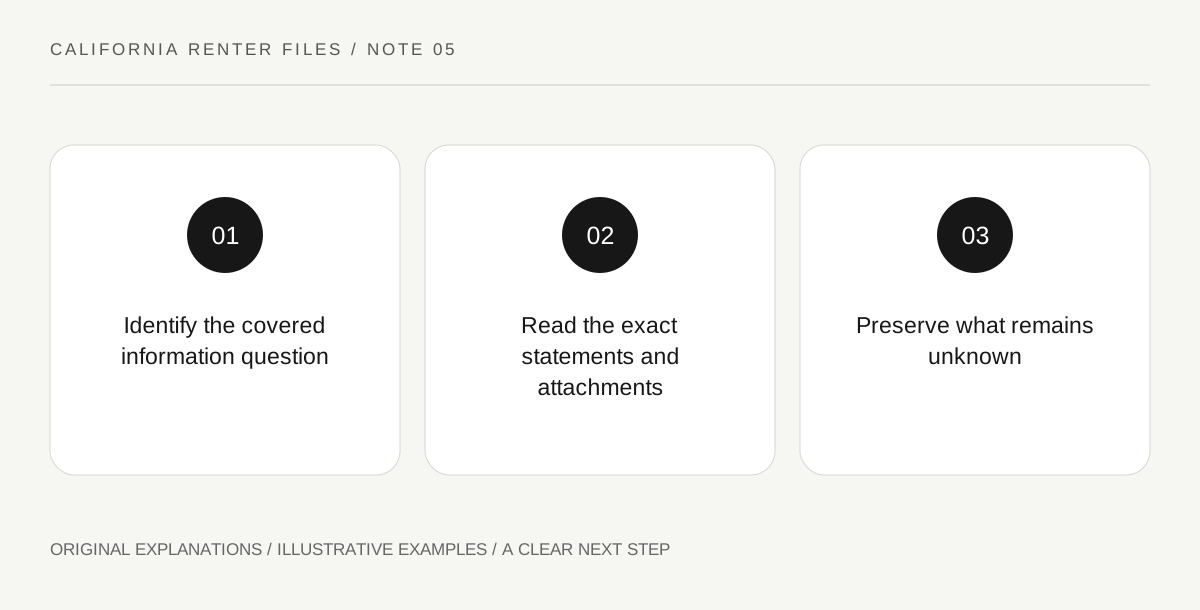
Original explanatory diagram. Read the full method and limitations below.
Identify the rule’s information purpose
EPA explains that the federal disclosure rule applies to most pre-1978 housing and requires disclosure of known lead-based-paint information before covered leases are signed, with exceptions. That is an information duty, not a universal statement that every older dwelling contains a hazard or that every signed form establishes absence. Record the property, the supplied construction information and the actual disclosure documents. Ask qualified help about coverage where needed rather than deciding an exception from a brief label.
Read each answer as written
Distinguish a statement of known information from a statement that the owner has no knowledge. Do not rewrite no knowledge as tested and clear in a household summary. Preserve any reports supplied and identify which parts of the property they concern. An assessment of one location should not silently become a conclusion about every painted surface. If attachments are referenced but missing, make that a concrete document question before assuming the package is complete.
Keep inspection and disturbance questions separate
If testing, renovation or a condition concern arises, use appropriately qualified resources and the responsible provider’s actual requirements. This article authorizes no scraping, sanding, sampling or cleaning method. Do not damage a surface to verify whether a disclosure seems accurate. A person can understand the paperwork without personally investigating the material. Keep any health concern with a qualified health professional and any work-related question with the relevant lead-safety and housing authorities.
Save an evidence-based summary
End the file with three headings: information supplied, referenced material received and questions unresolved. Keep the original disclosure and reports intact. Do not call the home lead-free unless appropriate evidence actually establishes that claim for the relevant scope. A useful summary helps a renter ask about missing information while preserving uncertainty honestly. It does not select a remedy, establish liability or replace current professional guidance about a particular property, occupant or proposed project.
Illustrative renter file
Illustrative summary: an applicant receives a form stating that the owner has no known information and sees a reference to a report not included in the package. The file lists the missing report as a question. It does not convert no knowledge into a lead-free certificate or disturb a wall to check. Any testing or work inquiry is directed to the appropriate qualified source.
Questions that come up
Does a signed disclosure certify that a home is lead-free?
No. Its meaning depends on the statements and supporting evidence actually supplied. The disclosure rule concerns known information in covered transactions.
Should I scrape paint to investigate the paperwork?
No such action is authorized here. Use appropriately qualified guidance for any testing or work question and avoid disturbing material to complete a worksheet.
References and scope
These sources support the factual background. Examples and exercises are original illustrative teaching material. References do not imply endorsement.
- EPA: Lead-Based Paint Disclosure Rule, Section 1018 of Title X — Known-information disclosure for most pre-1978 housing with exceptions; no property diagnosis, testing or lead-removal instruction.